Black Swans
Reflections on Decision Making Post SpaceX IPO

Two years ago, I was in a predicament.
I just quit my job and was oscillating between accepting one of two job opportunities. One was at a newly minted unicorn AI startup and the other was at X.
I walked through the city walk of Chicago, saying bye to the city and torturing myself about what decision to make.
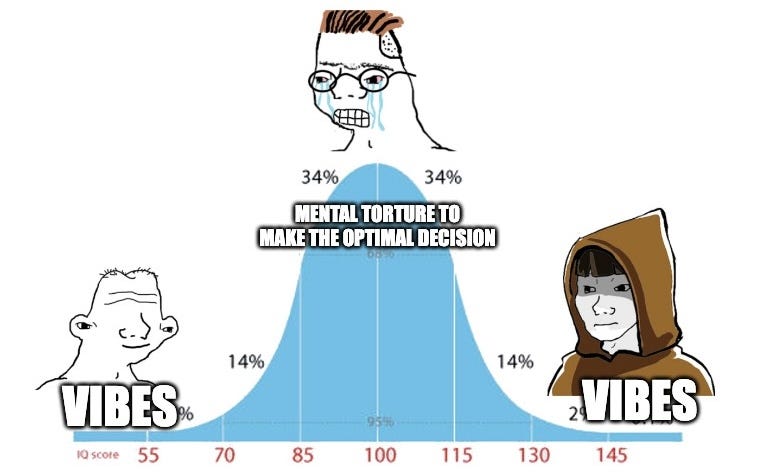
Being an over-thinker, I went through all the frameworks, thought along all the dimensions of company prestige, career opportunity, position titles, potential co-workers and projects.
I stared at spreadsheets charting out total compensation numbers based on sliding company valuation projections and hypothetical raises.
I consulted friends- those who knew me well, who worked in startups, and who worked in Elon companies.
It seemed every other day I arrived at a different conclusion: one day the startup made perfect sense. The day after, X suddenly made more sense.
When the deadline came after several weeks, I finally pulled the trigger and accepted the startup.
The next day I received an unexpected email. Soon, I decided to just follow my gut.
I reneged my decision and did what felt like a gamble.
History has been made with the SpaceX IPO.
A once nascent rocket company teetering on the brink of bankruptcy in a field dominated by governments and entrenched aerospace companies just had the largest IPO in history.
The world’s first trillionaire was crowned and thousands of employees—including many in ordinary blue collar roles—just became multi millionaires.
My decision that once looked idiotic now appears otherworldly.
No one could have predicted the series of events that led up to this moment.
A year prior, X was merged into xAI, which was then merged into SpaceX.
My bet on a devalued controversial social media app hemorrhaging money from fleeing advertisers somehow parlayed into a generational company that catches rockets with chopsticks.
All the mental models, decision matrices, scores of “utility”, and spreadsheet financial projections I plowed weeks into two years ago were completely inaccurate.
I could never had fathomed the magnitude of upsides.
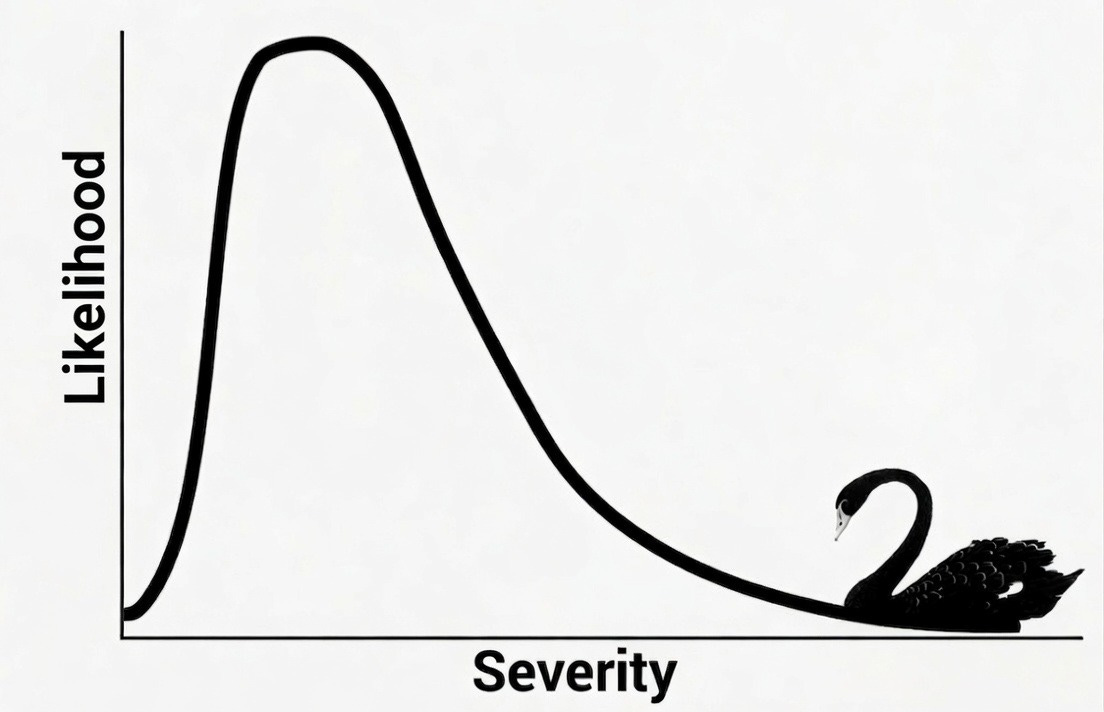
Black swan events are extreme outlier occurrences that come as complete surprises, have everlasting consequences, and are inappropriately rationalized in hindsight.
World War 1 was a black swan event. So was Black Monday and the 2008 financial crisis. Recently, there was the 2020 COVID pandemic.
There are black swan events that apply to our own lives as well.
In the context of decision making, these are the Rumsfeld Matrix’s unknown unknowns.
We can never imagine these things happening and can never predict their magnitudes.
The SpaceX IPO is an unknown unknown.
In the end, the outcomes of a decision can really just come down to damn luck.
If I committed to the startup like I originally had, I would have felt the deep regret of missing out from a massive positive black swan event.
In this regard, personal decision making frameworks are not necessarily used to optimize for the “best decision”—we truly can never predict what will be the “best.”
Instead, these frameworks are tools used to make us comfortable and confident during decision making.
How do we reach a decision that lets us sleep soundly at night?
For the yolo ones out there, no framework is needed. Just send it.
For me, I roll in mental jiujitsu, only feeling comfortable and confident when seemingly all unknowns and angles are explored; if I fail, I want to know I did everything I could to predict it in the first place.
Since black swan events exist and overshadow everything else, it appears we should bet on what feels right and do whatever diligence needed to feel comfortable about it.
It’s all vibes.