

Congratulations!
You’ve started!
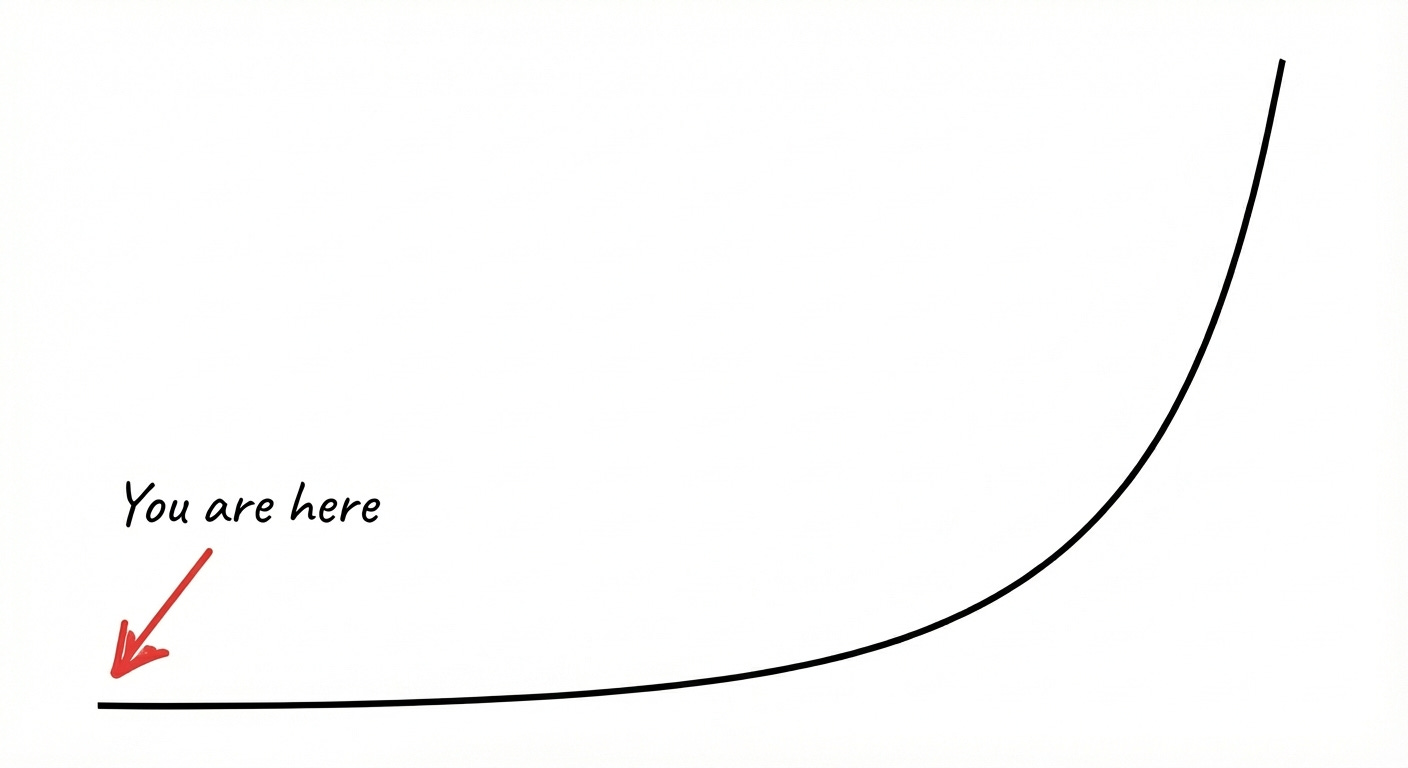
Now, you’re a beginner, hiking the initial slopes of the exponential-growth mountain.
There is nothing hiding the reality of the situation: you have no hiking gear, you can’t see the paths to take, and you have no promise of ever succeeding.
This is the beginning of exponential growth where the difficulty stems from little observable progress over an indefinite period of time.
For me, this bubbles up the fear of wasting my precious mid 20s prime in vain working towards something that may never come true.
Undoubtedly, the most important behavior to embody at this stage is having unshakable faith and being endlessly enthusiastic despite having, at best, no evidence— or usually evidence to the contrary.
I continuously need to convince myself to keep going.
Here are the mental models and the actions I find most helpful so far.
Reframing Disappointment
Honestly, I’m terrified of disappointment, having selected pretty conservative opportunities throughout university.
To be more risk seeking, I am reframing occurrences of disappointment as tests of personality.
Because being disappointed sucks, by picking up the pieces and trying again, I see myself passing a test and gathering another piece of evidence that I’m resilient.
It’s like building a personal Lindy Effect- the longer I keep going now gives me more evidence that I can keep going in the future.
It’s also like a passive commitment to Rejection Therapy, in which increased exposure to disappointment results in a decrease in its perceived negative impact.
Patterns of Starting New Things
The same experiences reoccur across new pursuits.
My present experiences of feeling like an idiot, not knowing what I’m doing, and being uncertain of the future have all been experienced previously.
I remember when I first went to the gym at 14.
I felt like an idiot in the presence of buff dudes in tank tops. I didn’t know what the hell barbells were. I didn’t know if or how I was going to get stronger.
In the face of all this, I’ve now hit PRs I never could have previously imagined.
Not only are these all pieces of evidence that I can accomplish despite starting as a novice, they also serve as reminders that the feelings I’m experiencing now are not new.
I’ve experienced the pains of starting out and I’ve gone on to achieve goals.
Why would this time be any different?
“Networking”
Networking gets a bad rap for being transactional, associated with finessing referrals and whatever else is spouted on LinkedIn.
But, I’ve found its biggest benefit is far more profound: undeniable external proof that my pursuit is actually achievable.
While reading biographies of the super accomplished can be inspiring, meeting a real person who is a little bit further along is much more relatable.
And while the specific steps taken by others may not be applicable, their stories illustrate that there isn’t some voodoo magic involved — only the long series of small actions in the face of uncertainty.
There are plenty of real life examples to draw inspiration to keep going.
The first rule of compounding is to never interrupt it unnecessarily
Charlie Munger
Is starting something new difficult?
Yes.
Should it not be difficult?
No.
If it isn’t difficult, everyone would do it, which, in turn, makes it less impressive to do so in the first place.
Just keep going and trust the wonders of compounding.