

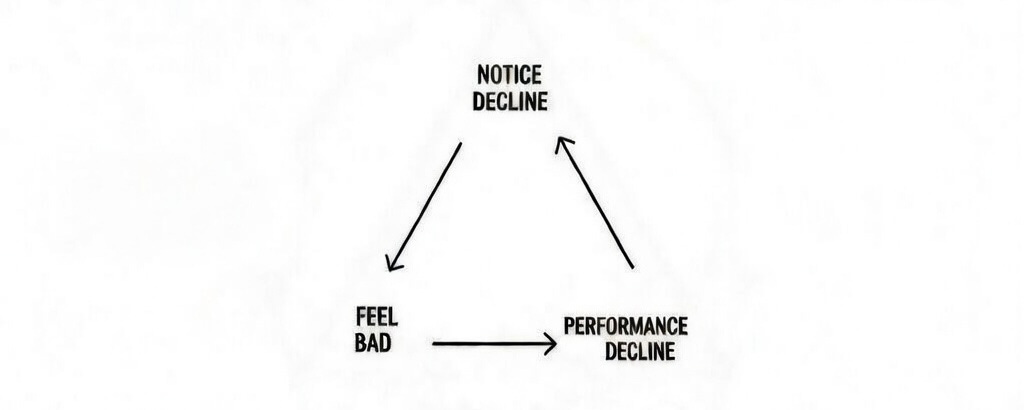
There’s a common pattern I’ve observed in type A people.
It starts with noticing some deficiency in self. The most common one for me is “I’m not being productive.”
This identified deficiency comes in tension against internal high expectations—“I should be productive.”
Then, self flagellation of not living up to personal standards grow and tap into underlying suspicions of insufficiency. Questions of “Why am I not productive?” morph into “Why am I not enough?”
Obviously, ruminating almost never resolves the issue, instead leading to more deficiency—stressing on not being productive is not productive.
The self perpetual machine now begins when the new additional deficiency is inevitably noticed.
This infinite regress productivity spiral seems to perfectly plague insecure overachievers, who usually are highly introspective, have high personal expectations, and deeply fear insufficiency,
The high introspection does not allow graceful ignorance. Deficiencies will always be noticed.
The high personal expectations starkly contrast against present deficiencies. Stress and self-enforced pressure to strive for impossible to reach expectations build.
The deep fears of insufficiency add fuel to the flame. Differences between reality and expectations readily serve as evidence of insufficiency and confirm pre-existing fears, thereby increasing stress and pressure.
This spiral extends beyond traditional realms of productivity, ironically popping up in type B settings.
In the past, I treated sleep—which is supposed to be for relaxing—as another productivity tool (better sleep = better work later). I reframed it into a dopaminergic pursuit that could be optimized and agonized over, much like work itself.
Fueled by wearables, I chased sleep PRs. Any downward blip became evidence that I was under-optimized and below my full potential.
Obviously, my sleep became terrible. Turns out, stressing about sleep does not help sleep, particularly when I’m trying to sleep.
So what’s the solution here?
While I haven’t found a singular silver bullet that works for me (I can’t simply “let it go,” nor do I have 129038120938 hours of meditation to become fully ascended), I’ve found that a combination of kindness and continual progress helps.
The first is taking the inverse of the Golden Rule: treat myself how I treat others.
If I extend grace, understanding, and patience to others in their struggles, why should I be an unrelenting tyrant toward myself?
It’s ok—not ideal, but ok—to move slower than what my inner drill sergeant demands. I am not and will never be perfect.
It’s also ok to beat myself up. I shouldn’t be beating myself up over beating myself up. And if I do, that’s ok too.
Furthermore, it’s ok to feel bad for not reaching my expectations. It’s only natural given the high expectations.
In the midst of this kindness, there is profound solace in knowing that the tried and tested way out is to continuously make progress, falling back on whatever systems available.
No matter how small, these defiant pieces of progress serve as evidence, going against the grain of insufficiency and contributing more toward morale than even large leaps gained during optimistic times.
They feed into the realization that internal thoughts and external actions are independent.
Despite feeling terrible, I can still perform enough that an external observer will never know my internal strife.
And if I somehow still find myself spiraling in the face of kindness and effort, I can always fall back on several nights of good sleep.
(as long as I’m not trying to set sleep PRs)